Introduction
Have you ever wondered where the ideas of “freedom” and “democracy” actually began?
Thank you for reading this post, don't forget to subscribe!The answer lies in 18th-century France.
The French Revolution (1789-1799) was no ordinary event. It was a terrible, yet necessary, storm. This storm destroyed a monarchy that ruled France for centuries.
Just imagine: a king who thought he was God’s representative on Earth. Meanwhile, ordinary people struggled to find even one piece of bread. Anger was bound to explode.
This revolution not only removed King XVI from his throne but also taught the whole world a powerful lesson. True power does not lie in grand palaces. It rests in the hands of the people.
What Was the French Revolution?
The French Revolution was a period of huge political and social change. It lasted ten years, from 1789 to 1799. It was not a single event, but a chain of events that shook France to its core.
The revolutionaries fought for liberty, equality, and fraternity. They ended the rule of kings and began a new age of citizen power.
Main Causes of the French Revolution
No revolution happens overnight. Years of anger and pain hide behind every revolt.
By the late 1700s, France had become like a pressure cooker. The whistle was about to blow. Let us look at what was cooking inside.
Social Inequality: The Three Estates
The biggest problem was how French society was divided. At that time, society was split into three groups, called the Estates. This division was so unfair that it would make anyone angry.
First Estate: The Clergy
This group included church leaders and high-ranking priests. They were only 1% of the population. But they owned nearly 10% of all the land in France.
The most shocking part? They paid no taxes to the government. Instead, they collected a religious tax called the “tithe” from poor farmers.
Second Estate: The Nobility
This group included the king’s relatives, landlords, and rich nobles. They made up barely 2% of the population. Yet they controlled 25% of the land.
Like the First Estate, they also paid no direct taxes to the state. They lived in beautiful palaces and enjoyed the wealth earned by ordinary people.
Third Estate: The Commoners
Now, let us talk about the people who carried the entire country on their shoulders. This group had farmers, laborers, shopkeepers, lawyers, and the poor. They formed a huge 97% of the population.
Do you think they were treated fairly? Not at all.
The Third Estate paid all the taxes—both direct and indirect. They had no land, no rights, and often no food to fill their stomachs.
Economic Crisis and Heavy Debt
By this time, France’s treasury was completely empty. Why?
King Louis XVI and his queen, Marie Antoinette, spent money without any limit. Their wasteful lifestyle was legendary.
On top of that, France helped America fight for freedom from Britain. This war cost France billions of “livres” (the currency then). The country was drowning in debt.
When the treasury dried up, the king thought, “Let us raise taxes on the Third Estate again.” That thought was the spark that lit the fire.

The Influence of Philosophers and Thinkers
When stomachs are empty, the mind works harder.
During this time, great thinkers like Rousseau, Voltaire, and Montesquieu woke up the people through their books and speeches.
Rousseau famously said, “Man is born free, but everywhere he is in chains.”
These ideas planted the seeds of equality and freedom in the minds of the educated middle class, who were part of the Third Estate.
Timeline of the Revolution
| Years/Date | Event | What Happened |
| May 1789 | Meeting of the Estates General | King Louis XVI called a meeting to raise taxes. The Third Estate protested against the unfair voting system. |
| 14 July 1789 | Fall of the Bastille | The people of Paris attacked and destroyed the Bastille prison. This marked the beginning of the end of the monarchy. |
| August 1789 | Declaration of Rights | The “Declaration of the Rights of Man and of the Citizen” was issued. It established liberty, equality, and fraternity as core principles. |
| January 1793 | King’s Execution | Louis XVI was publicly executed by guillotine for treason. |
| 1793–1794 | Reign of Terror | Led by Maximilien Robespierre, this was a period of fear. Thousands of people were executed. |
| 1799 | Rise of Napoleon | Napoleon Bonaparte came to power, marking the end of the revolution. |
Key Stages and Events of the Revolution
By now, the pressure cooker had exploded. Events moved so fast that nobody got time to breathe.
The Meeting of the Estates General (1789)
In May 1789, the king called a meeting of the Estates-General—a kind of parliament. He wanted to raise more taxes.
As per the old rule, each estate got only one vote. That meant the rich (First and Second Estates) could always win 2-to-1 against the Third Estate.
The Third Estate protested and demanded that each person should have one vote. When the king refused, the Third Estate bravely declared itself the National Assembly.
The Historic Fall of the Bastille
14 July 1789 – This date is written in golden letters in history.
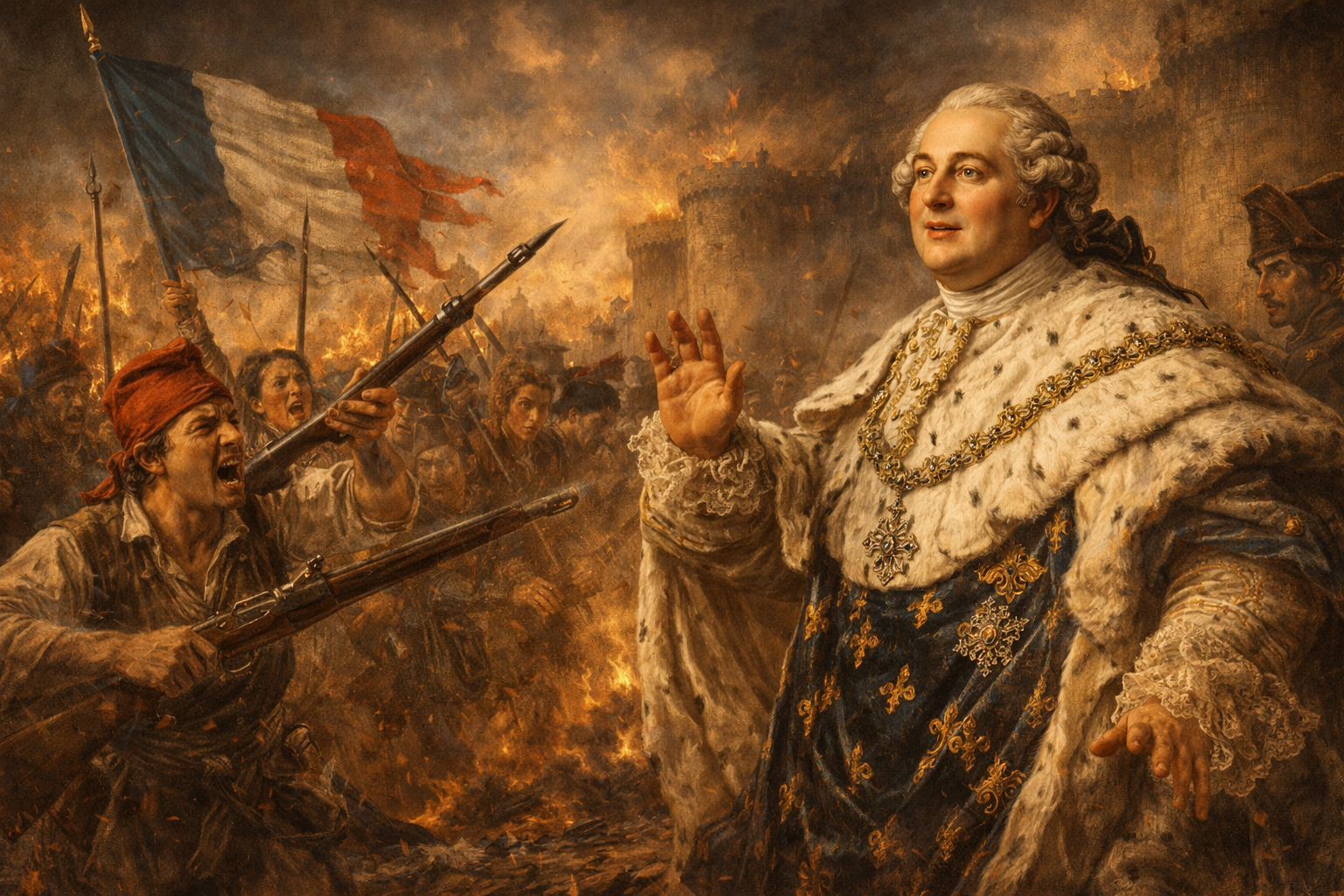
An angry crowd in Paris attacked the Bastille fortress. The Bastille was a symbol of the king’s dictatorship. It held political prisoners who spoke against the king.
The crowd destroyed the fortress. This was not just the fall of a building. It was the fall of the monarchy’s pride.
Today, France still celebrates 14 July as Bastille Day, its national holiday.

Declaration of the Rights of Man and of the Citizen
In August 1789, the National Assembly passed a landmark document: the Declaration of the Rights of Man and of the Citizen.
This document was a game-changer. It clearly stated that all human beings are born free and with equal rights. Liberty, property, security, and the right to resist oppression were declared natural rights of every person.
The Reign of Terror
Revolutions are not always peaceful.
The period from 1793 to 1794 was the most frightening chapter in French history. It is called the Reign of Terror.
After King Louis XVI was tried for treason and executed by guillotine, things spun out of control.
Robespierre and the Fear of the Guillotine
Power fell into the hands of Maximilien Robespierre and his Jacobin Club. Robespierre believed that he had to take harsh steps to save the revolution.
He sent anyone he suspected of being an “enemy of the revolution” to the guillotine—the beheading machine. Among the thousands of people killed was the former queen, Marie Antoinette.
Eventually, even the people grew tired of this fear. Robespierre himself was arrested in July 1794 and sent to the same guillotine.
The Rise of Napoleon and the End of the Revolution
The weak government left in charge after Robespierre’s fall was called the “Directory.” But there was still instability, corruption, and economic crisis.
A young and ambitious military officer took advantage of this chaos. They called him Napoleon Bonaparte.
In 1799, he took power and announced he was the ruler. The French Revolution, technically, ended with the rise of Napoleon. But the ideas of revolution never faded away.
The French Revolution’s Impact on the World
The French Revolution did not remain within France. The impact was global.
So powerful was the slogan “Liberty, Equality, Fraternity” that it altered politics and society in many countries.
People began to speak out against the monarchy all over Europe. New revolutions were ignited.
Even India felt the effect. These ideas inspired leaders, including Tipu Sultan and Raja Ram Mohan Roy.
And today we discuss democracy and rights and equality, all of which have their origins in this revolution.
The French Revolution, in summary, taught the world that all men are entitled to equality and liberty.
Summary
So, friends, the French Revolution was not just a simple uprising.
It was a turning point in human history. It destroyed feudalism. It planted the seeds of modern nationalism and democracy.
Yes, there was bloodshed. Yes, mistakes were made. But the revolution gave the world a very big lesson:
When a ruler ignores the voice of the people and exploits them, the dam of public patience will break one day. And when that dam breaks, even the mightiest thrones come crashing down.
Frequently Asked Questions
What was the Bastille, and why was its fall so important?
The Bastille was a fortress and prison in Paris. It was seen as a symbol of the king’s tyranny. Its fall on 14 July 1789 proved that the absolute power of the king had come to an end.
Who was part of the Third Estate?
The Third Estate included 97% of France’s ordinary people—farmers, landless workers, shopkeepers, craftsmen, and educated middle-class people like lawyers and doctors. They had to pay nearly all the taxes.
Who started the Reign of Terror?
The Reign of Terror (1793–1794) was mainly led by Maximilien Robespierre. In the name of eliminating “enemies of the revolution,” he sent thousands of innocent people to the guillotine.
How did the French Revolution end?
The revolution ended in 1799 when Napoleon Bonaparte seized power in a military coup. He took advantage of the political instability and failures of the Directory government.